Immutable History: Why We Chose Besu
Every architecture decision is a trade-off. When we sat down to design the TruthRegistry—the immutable ledger at the heart of Silversparre—we found ourselves staring at an impossible trilemma:
- Scalability: Can it handle millions of assets from global publishers?
- Decentralization: Can it survive if any single company, including us, disappears?
- Privacy: Can enterprises trust it with metadata they don't want exposed to competitors?
A traditional SQL database offered speed—but it was a single point of failure. One breach, and history could be rewritten overnight. Public blockchains like Ethereum Mainnet offered immutability—but they were too slow (15+ second finality), too expensive (gas fees), and far too public. Enterprise metadata doesn't belong on a ledger anyone can read.
We chose a third path: Hyperledger Besu, running in a permissioned IBFT 2.0 configuration. The best of all worlds.
The Administrator Problem
Why not just use Postgres with a really strong password? Because of the Administrator
Problem. In any centralized system, there is always at least one "super-admin" who has
DROP TABLE privileges. If that person is bribed, blackmailed, or hacked, the history of
truth is compromised.
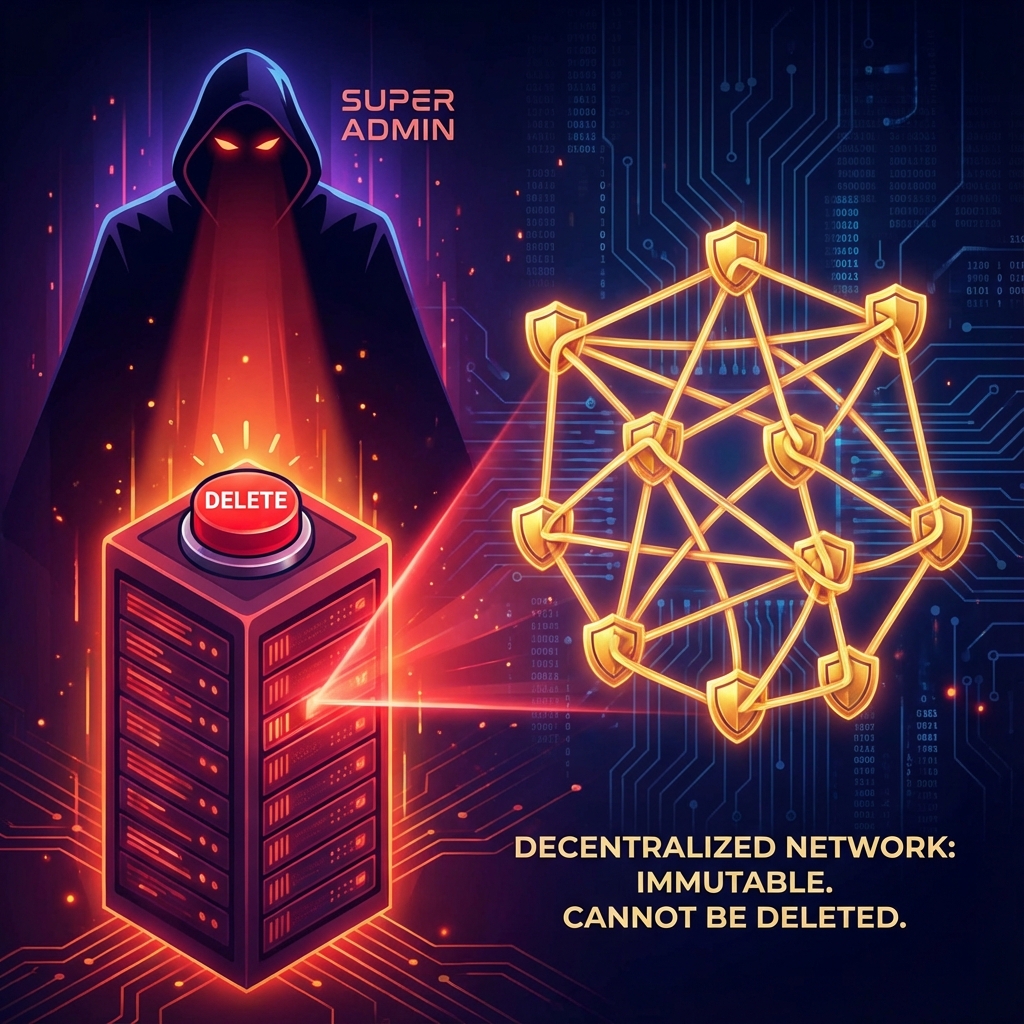
We don't trust admins; we trust math. In our consortium model, no single entity—not even Silversparre—has the power to rewrite the ledger. To alter a historical block, you would need to simultaneously compromise the private keys of a majority of international validators (e.g., the New York Times, Amnesty International, the BBC). It moves the attack vector from "hack one admin" to "hack the world's media infrastructure."
The Numbers That Matter
- 2-second block time. Near-instant finality. Your signature is etched in stone before you finish blinking.
- Zero gas fees for publishers. The consortium absorbs costs—validators, not users, pay to run the network.
- Proof-of-Authority consensus. Validators are known, trusted entities—news agencies, NGOs, academic institutions—rotating responsibility like a digital shift change.
The Physics of Finality
IBFT's killer feature isn't speed—it's finality. In Proof-of-Work systems like Bitcoin, finality is probabilistic. You wait for 6 confirmations and say, "It's 99.99% likely this won't change."
Courts don't like "probably." Legal evidence requires certainty. With IBFT, finality is deterministic. Once a block is committed, it is mathematically impossible to fork or reorganize without gathering digital signatures from 66% of the validators. It provides the "digital certainty" required for admissibility in a court of law.
Privacy Groups, powered by Tessera, let us share sensitive metadata between specific parties—say, a publisher and an auditor—without broadcasting it to the entire network. Selective disclosure, built into the protocol.
And because Besu runs a standard Ethereum Virtual Machine, we write our smart contracts in Solidity—the same language powering billions of dollars in DeFi. Battle-tested. Auditable. Familiar.
If history can be edited, it's just memory. We chose to build on the only foundation where editing is mathematically impossible.