The AI Arms Race: Automated Deception
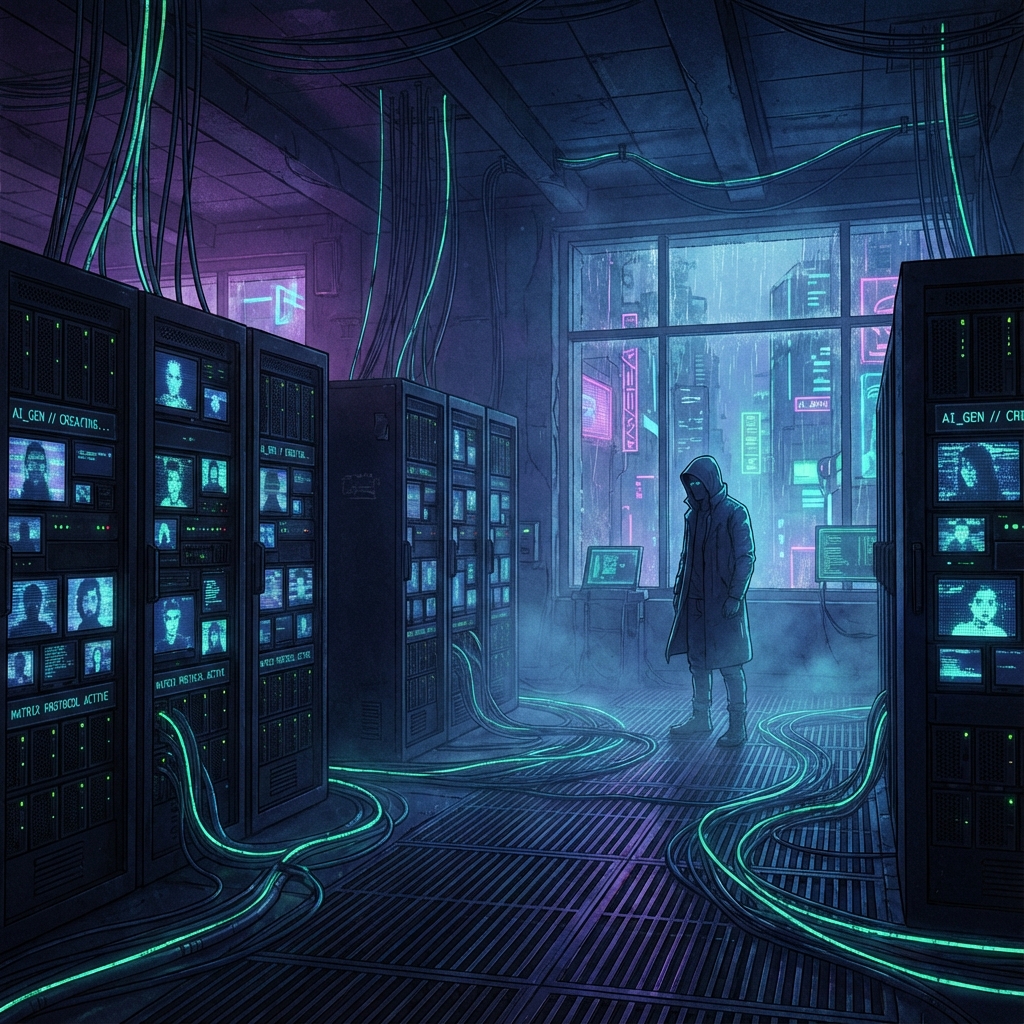
Picture a warehouse in a nondescript industrial park. Inside, rows of servers hum through the night, their fans whirring like a mechanical heartbeat. No humans are present. The machines are churning out something far more dangerous than malware—they're manufacturing reality itself.
The era of the "lone wolf" photoshopper is over. In 2024, we witnessed something unprecedented: the industrialization of synthetic media. State actors and organized crime syndicates aren't crafting deepfakes by hand anymore. They're building pipelines—automated systems that can generate a thousand convincing lies before a human fact-checker finishes their morning coffee.
Open-source research and incident reports paint a troubling picture. We're seeing an explosion of "Mule Accounts"—synthetic identities spun up en masse, complete with faces that never existed and video verifications that fool basic KYC (Know Your Customer) checks. These digital ghosts don't just exist; they act. They share. They comment. They amplify. They are the invisible infantry of disinformation campaigns.
The Democratization of Deception
It used to take a Hollywood studio millions of dollars to put a digital face on a stunt double. Today, a 16-year-old with a gaming GPU can train a LoRA (Low-Rank Adaptation) model on a target's face in under an hour.
The barrier to entry has collapsed. We aren't just fighting state-sponsored labs anymore; we're fighting scripts. Tools like AutoGPT combined with ElevenLabs voice cloning APIs allow attackers to automate the entire "social engineering" lifecycle. A script can now:
- Scrape a target's LinkedIn and Twitter to build a psychological profile.
- Clone their voice from a 30-second webinar clip.
- Generate a personalized phishing call to their subordinate authorizing a fund transfer.
All without a human operator ever touching a keyboard. This is the democratization of deception.
The Three Horsemen of Automated Deception
This new underworld runs on three core attack vectors:
- Mule Account Factories: Scripts that spin up thousands of social profiles overnight, each wearing a GAN-generated face so realistic it passes liveness detection. By Monday morning, an army of synthetic citizens is ready for deployment.
- Content Injection: Why build an audience when you can hijack one? Attackers compromise CMS credentials and API tokens to slip deepfakes directly into legitimate news feeds—a Trojan horse wearing the mask of trusted journalism.
- Feedback Loops: The most insidious innovation. Engagement metrics—likes, shares, the dopamine breadcrumbs of social media—are fed back into the generator in real-time. The machine learns what goes viral. It evolves. It gets better at deceiving you with every click.
The Economics of a Fake
Let's talk numbers, because that's what drives this industry. The cost of generating a unique, high-fidelity image has dropped from $10.00 (manual editing) to $0.003 (Stable Diffusion API).
An attacker can now drown the zone with noise for the price of a cup of coffee. When the marginal cost of producing a lie approaches zero, truth becomes an expensive luxury. Fact-checking is slow, expensive, and human-bound. Generation is instant, cheap, and infinite.
The asymmetry is brutal. On one side: human moderators, bleary-eyed, clicking through flagged content. On the other: generative adversarial networks iterating on deception strategies at the speed of silicon. Defense must be automated because attack is already automated.
This is precisely why we built Silversparre around provenance, not detection. Detection is a treadmill—you're always one step behind the generator's next trick. But a valid cryptographic signature? That's different. It cannot be forged without the private key. It doesn't care how realistic the pixels look. It asks one simple, devastating question: "Can you prove where this came from?"
In a world where seeing is no longer believing, the signature is the only solid ground left.